The Logos and The Truth
An exploration of Jesus Christ, the Logos, and Ludwig Wittgenstein
Jesus Christ and The Logos
The beginning of the Book of John says that Jesus Christ is the Word, and the Word was present in the very beginning.
There’s just one issue with Jesus as the “Word.”
It’s a translation so inaccurate that it might as well have said, “in the beginning God was a cat.” When I found out what the original sentence meant, I felt I had been robbed. Once you find out, you’ll feel the same way.
Word is translated from the Greek “Logos,” which is an entirely different concept from “word.” Logos means something like reason, ordering principle, the rational structure of the universe, and divine reason giving form to creation. We could translate those first few lines of John as saying something like:
“In the beginning was the Logos,
and the Logos was with God,
and the Logos was God.”
Knowing what Logos actually means gives these first few lines an entirely different meaning than just saying “Word.” It means the way of Jesus is the way of truth. After all, if you’re going to be the divine reason giving form to creation, it probably has to be the truth, right? It also means Jesus Christ, who is the ordering principle of the universe and the way of truth, was present in Genesis 1:1.
That means that when God created the earth from the formless chaos of the water, Jesus was there and a crucial part of it. But knowing what Logos means, it implies that the creation was not God creating like a wizard making things appear, but rather naming things that were in existence.
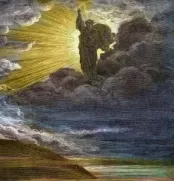
We can see the roots of the scientific revolution here. Philosophers like Francis Bacon and René Descartes specifically said that to glorify God, rationally naming his creation was of ultimate importance.
This interpretation also begs a question. What is the nature of the truth claims that arise from Genesis 1:1? Are they the physical and scientific truth claims that atheists and fundamentalists often claim?
Let’s back up a bit and talk language games.
Language Games
Wittgenstein, one of the most important philosophers ever, said one of the most interesting things ever about language. He said that the context of a language changes its interpretation completely. He formulated this principle by developing an idea called language games. This idea comes from his Philosophical Investigations.
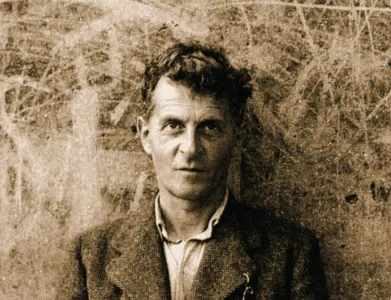
Consider the example he uses: if a bricklayer says “brick” to his fellow worker, that worker probably knows that the bricklayer wants another brick. Now consider my example: If you’re crossing the street with a friend and you say “brick,” your friend might think you have a concussion. That’s an entirely different context, and the utterance has a completely different meaning.
This might seem like something that’s dead obvious, but is it? Many atheists constantly claim that the language of the Bible MUST be interpreted as a scientific truth claim. They assert that the meaning of that language can only be interpreted in one way.
That makes no sense at all!
Nearly all human language is contextual, as Wittgenstein asserted. Not only that, but a large majority of our language does not contain objective physical world truth claims, and yet we still function just fine. Much of our language contains metaphorical usages of words, and yet we understand exactly what people mean.
Consider these examples:
“I’m feeling down today.”
“I look up to that guy.”
“That argument was an absolute battle.”
“Your assertion has no foundation.”
Where is the objective truth claim that can be measured within any of these sentences? How is an argument a battle? How do you look “up” to someone exactly? Are they above you?
There are no scientifically verifiable truth claims in each of these questions, but we still understand what these sentences mean. Thus, metaphorical language is a perfectly valid way of understanding reality. The more you investigate it, the more you realize nearly all of our conversations about our lives are this way. This observation is further explored in cognitive scientist and linguist George Lakoff’s book Metaphors We Live By. I highly recommend it.
The language of goals, friendships, and our life stories is mostly metaphorical in its most important details. We’re perfectly capable of assessing the truth claims implicit in a metaphorical sentence like “I’m feeling down today” or “I moved a bit closer to my goal today.” So, why, if we understand language without scientific truth claims in our daily lives, do we fail to understand the language of religion?
Language Games and Religion
When John says, in the beginning, there was the Logos, it’s not clear what language game he’s playing, though I think I have an idea.
Political Philosopher Eric Voegelin spends dozens of pages in his 5th volume of Order and History just unpacking those first few lines of Genesis. He distinguishes between two types of language, calling them the languages of the It-world and the language of the Thing-world. The It-world is where symbolic language is used to describe Being as it is. The language of the Thing-world is where scientific, physically descriptive language exists. It should be noted that this assertion that much religious language is symbolic or allegorical is agreed upon by many early Christian church fathers, such as Origen, St. Augustine, and Philo.
My assertion is along the lines of Voegelin’s. We use different language in our attempts to describe different things, and a description of the symbolic (religious) world is much different than a description of the physical world. Nonetheless, truth can be assessed in both worlds, and we understand both truths.
I’ve taken to calling the language of the Thing-world, the science language game, and the language of the It-world the Logos language game.
Both of these uses of language have a similar goal in mind: to describe the nature of reality itself, but the scientific language game attempts to describe things as they actually physically are as accurately as possible. This means that the truth claims that scientific language makes can be verified in the objectivist sense. So, if you say, “Bob traveled from New Orleans to New York in 22 hours,” we can empirically verify this statement.

The Logos language game attempts to describe the nature of reality as well, but it often does so through metaphorical language. It’s harder to understand the truth claims that come out of someone playing the Logos language game, because symbols and metaphors stand for other things. It’s not so hard when it’s done with emotional language, because we are trained from birth to understand these things. If we do it with religious language, which is a multilayered version of symbolic and emotional language, it’s quite different.
The language of Genesis appears to be the Logos language game. The Logos language game is where man dances on the limit of his language in an attempt to describe underlying realities. It’s the language of philosophers and religious figures. It is richly metaphorical, symbolic, and not straightforward. Many of these metaphors are shared across religions, which points to a shared language game structure. Let’s look at some religious statements from the Bible to see this point illuminated.
John 6:35 from the King James Version:
“And Jesus said unto them, I am the bread of life: he that cometh to me shall never hunger; and he that believeth on me shall never thirst.”
Jesus Christ was obviously not a loaf of bread, so what’s going on here?
Or take John 14:6 from the King James Version:
“Jesus saith unto him, I am the way, the truth, and the life: no man cometh unto the Father, but by me.”
There’s an underlying implication from both of these statements that to “be like Christ” or to act like him is the best way to live life. You simply can’t understand these statements by interpreting them to mean that Jesus is literally a loaf of bread or literally “the way.” There must be a metaphorical translation to understand the meaning here. Jesus made it somewhat obvious that he was speaking metaphorically throughout the Gospels, but this isn’t clear in many other religious texts.
Take the Mesopotamian origin story, for example.
In this story, Marduk, a God who speaks magic words and has eyes all around his head, defeats Tiamat, the saltwater god of chaos, destruction, and creation, and creates the world from her body. He also defeats Kingu, the head of the demons, and makes humans from his blood.
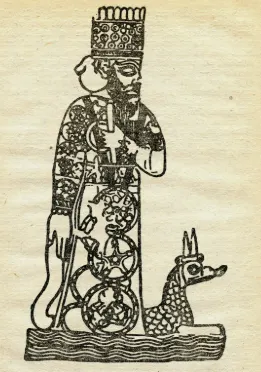
If that’s a truth claim, it’s a pretty crazy one, but if you compare its conceptual similarities to the origin story in Genesis, some underlying patterns emerge that appear to make the truth claims more understandable. As a quick example, God in Genesis makes the world from water. Jesus is also called the Logos in John, or true speech, which defines the world, and Marduk “speaks magic words.”
If we view metaphors as tools to navigate the world of Being, language derived from the Logos game is perfectly reasonable. We know what someone means when they say “I look up to this person” or even when they say, “I was once lost, but now am found.” If we view Jesus’s statement about bread as an implication that his way of life “feeds your soul” or is the best way to live, the truth claim becomes much more… digestible.
If we view truth as the language of science does, and only view it through that lens, then a statement like “I look up to someone” or “Jesus is the bread of life” could never make any sense. But we know that these things do make sense.
It makes sense because human beings understand truth in more ways than one. We can verify claims that are not scientific perfectly well.
When atheists demand that the truth claims of the Bible be scientifically verifiable, they erase an entire dimension of truth and with it, the ability to truly understand the human experience. If you force Genesis to speak only in the language of science, you’ll keep hearing ‘In the beginning God was cat’ — and miss the Logos entirely.